My Favorite Marches
Copyright 2007, 2013 by Ronald B. Standler
Table of Contents
Introduction
My Favorite Marches
Links to websites about composers of marches
Links to publishers of sheet music
Links to recordings of band music
Links to band websites
Introduction
I have enjoyed listening to military band music since the mid-1950s, when my mother purchased a
phonograph record of French and American military marches, recorded by the Band de la Garde Républicane
and sold in the USA on the Angel record label, a label normally devoted to recordings of classical music.
During approximately 1850 until the 1930s, life in the USA included community bands
that played marches, polkas, and other short works.
Before commercial radio stations (radio began in 1920s) and television (began around 1950),
people made their own entertainment, and community bands were part of that
entertainment. Many of the better bands (e.g., Dodworth's Saxhorn Band,
Claudio S. Grafulla's 7th Regiment Band of the New York State Militia, Sousa's Band
during 1892 until 1932)
toured the nation, giving concerts.
By the 1940s, jazz had replaced marches as popular music in the USA.
My criticism of most recordings of military band music is that there is too much emphasis on the
percussion instruments, and often the brass instruments overwhelm the woodwind instruments (particularly the tuba,
which often has little to contribute to either the melody or harmony).
After I purchased a computer-controlled synthesizer in May 1992, I experimented with arranging
some of Sousa's marches for a string ensemble. I was pleasantly surprised to see that such arrangements
could expose the real music contained in the band version. The Washington Post March is
particularly suited for strings. I have read that the original version of that march was composed in 1889
not as a march, but as a two-step dance to be played at an ice cream social sponsored by that newspaper.
In looking at sheet music for concert versions of Sousa's marches, I sometimes found ornaments
and syncopation that were omitted from sheet music intended for school/college bands.
Including such ornaments and syncopation in my arrangements made the march sound
more like classical music for an orchestra.
In 1993, I was not able to find a retail music store in the USA that would sell me
authentic versions of French or German military marches.
The development of the Internet makes it easier to find obscure publishers of military marches worldwide.
I have posted this webpage to make it easier for other people to find music for these
military marches.
My Favorite Military Marches
The following are my personal favorite marches.
- American marches:
- Sanderson: Hail to the Chief
- Sousa: Belle of Chicago
- Sousa: El Capitan
- Sousa: High School Cadets
- Sousa: King Cotton
- Sousa: Semper Fidelis
- Sousa: Thunderer
- Sousa: Washington Post March
- French marches:
- J. Alazard: Saint-Cyr
- Gabauer: Premier pas de Manoeuvre
- Duvernoy: Deuxieme pas de Manoeuvre
- Hoering: Marche de la Légion Etrangère
- Mehul: Le Chant du Départ
- G. Meister Le Grenadier du Caucase
- G. Parès: Trocadéro
- F. Romain: Sonnez Clairons
- Wettge: Défilé de la Garde Républicaine
- ?: Pas Cadénce des Sans-Culottes
- ?: Les Trainards
- German military marches
- Michael Haydn: Der Koburger Marsch (composed in 1793)
- anonymous: Herzog von Braunschweig
- Möllendorf: Parademarsch Nr. 1 (composed in 1846)
- Scherzer: Bayerischer Defiliermarsch (composed in 1850)
My Favorite National Anthems
In selecting these anthems, I only judge the music, not the words,
and not the country. In alphabetical order:
- Austria-Hungary (1797-1919) "Gott erhalte Franz den Kaiser,"
composed by F.J. Haydn. The melody is the subject of variations in the slow movement of
Haydn: String Quartet Op. 76, Nr. 3, the so-called "Kaiserquartett".
In the year 1841, a German hijacked this music for an anthem with words
"Deutschland über Alles." history
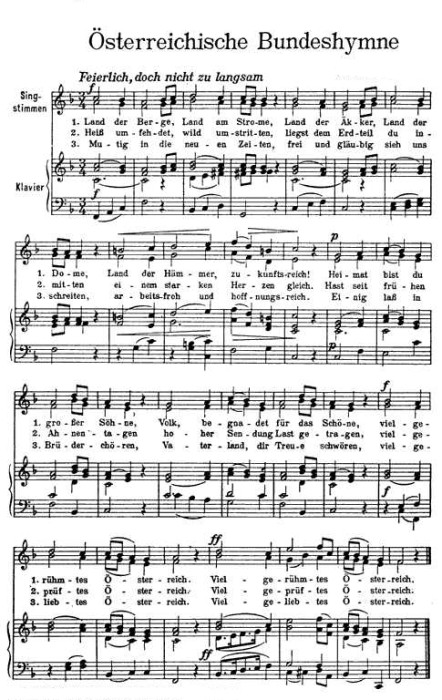
- In 1947 Austria adopted a new national anthem, "Land der Berge, Land am Strome,"
from a melody by W.A. Mozart.
Österreichische Bundeshymne,
official
sheet music for soprano, alto, and Klavier on page 2 of 3.
Alternative sources for the sheet music are:
Wien-Konkret,
NationalFeiertag, and
TU-Graz.
- Belgium: La Brabançonne
Excellent webpage by nongovernmental organization.
- Canada: O Canada
The official version contains only a soprano voice with no harmony.
- France: La Marseillaise
- Norway: "Ja, vi elsker dette landet"
Nongovernmental organization
Webpages about national anthems:
- nationalanthemns.info by David Kendall
has history, MIDI files, lyrics, and sheet music for more than 400 anthems.
- U.S. Navy Band MP3 files
Composers
John Philip Sousa
Publishers of sheet music for military marches
- Alfred published some of Frederick Fennell's
arrangements of Sousa marches.
- Alphonse Leduc publishes some French military marches
- C.L. Barnhouse in Iowa publishes
162 works by Sousa, including 21 of Keith Brion and Loras Schissel's
arrangements of Sousa's marches.
- Bote & Bock, music publishers in Berlin, was purchased in 1997 by Boosey & Hawkes.
Bote & Bock published 165 marches in two-volumes, titled Deutsche Armeemärsche.
- Carl Fischer published concert versions of Sousa's
marches. Fischer seems to have purchased Harry Coleman Co. in Philadelphia,
the original publisher in the 1880s and 1890s of many of Sousa's marches.
Since 2004, Theodore Presser (see below) sells Fischer's publications.
- Wilhelm Halter in Karlsruhe, Germany
- J.V. Music has brass quintet music
of the American Civil War era.
- Verlag Louis Oertel in Hannover, Germany published many marches since its founding in 1866,
but ceased business in the year 2006.
- Theodore Presser publishes many of Sousa's marches,
including many of Frederick Fennell's arrangements:
El Capitan, King Cotton, and The Washington Post March.
In 1930, Presser purchased the John Church Company, one of the original publishers of Sousa's marches.
Since 2004, Presser and Carl Fischer have common ownership, but continue to maintain
separate identities.
- Rundel in Germany
- Schott publishes
Friedrich Deisenroth (editor): Deutsche Armeemärsche, 59 pp.
retail stores:
See my list of sources for sheet music for classical instrumental music
at www.rbs0.com/music.htm
Fest-Musik-Haus in Texas (USA) imports German and European marches
recordings of military marches
See my general list of sources for recordings of classical music at
www.rbs0.com/music4.htm
Bundeswehr CD production
Corelia French manufacturer of CDs
retail stores:
Discurio retail store in England
links to band websites
Some of these websites contain downloadable recordings, copies of sheet music,
history, etc.
This document is posted at
http://www.rbs0.com/music3.htm
created 24 Dec 2007, revised 27 Jan 2013
return to R. Standler's homepage
go to my other webpages on music